Woodland Pathways Publishing
Books for the woman who is trying to find her way back
A five-book series following the Woodland Pathways Model, one book for each stage of the way through betrayal. Written by Teresa Zuvela, LMHC, from twenty-five years of sitting with women in exactly this.
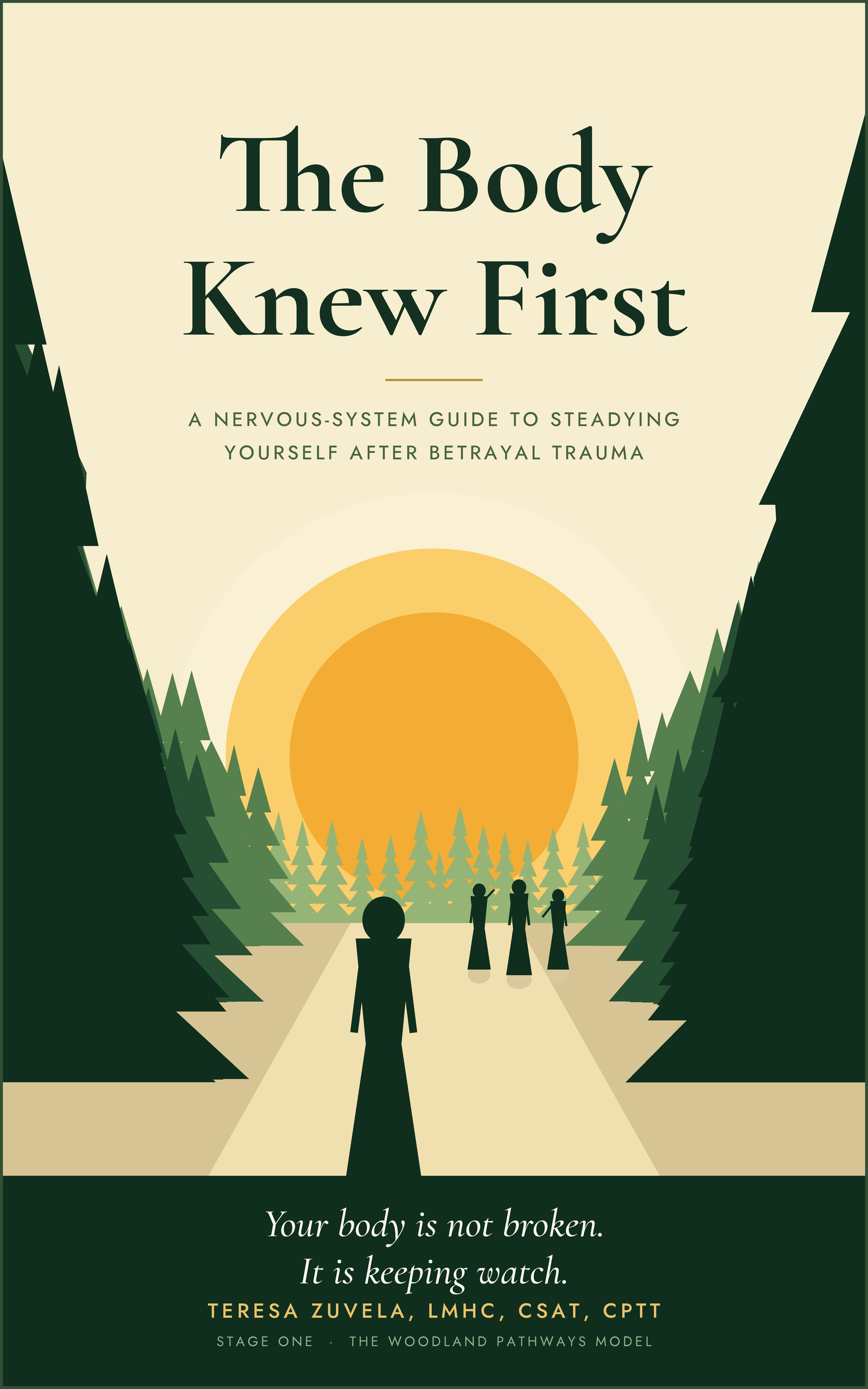
Book One · The Stabilize Stage
The Body Knew First
A Nervous-System Guide to Steadying Yourself After Betrayal Trauma
Before you knew, your body knew. The tightness that arrived without a reason. The sleep that stopped working. The sense that something was wrong, held for months against every assurance that nothing was.
This is a book about what happens in the body when the person you built your life around turns out to have been someone else. Not what to do about the relationship — that comes later, and it comes easier once you can think again. This is about getting your body back to somewhere steady enough to stand.
You are not broken. Your nervous system did exactly what it was built to do.
Written in plain language, with the physiology explained the way Teresa explains it in session — no jargon, no pathologizing, and no pressure to have decided anything.
Available on Kindle and free to read with Kindle Unlimited.
What is inside
Why you cannot think
The racing mind, the 2 a.m. loop, the searching that never resolves — and why thinking harder makes all three worse rather than better.
Why a sound can undo a day
How a notification tone or a particular room can move your whole body in under a second, and why the shame that follows is the heavier half.
What actually settles it
Body-first practices you can use in the moment, drawn from the Stabilize stage of the Woodland Pathways Model, with diagrams and clinical notes throughout.
The Woodland Pathways series
Five stages, five books. The path is not a straight line — women move forward and circle back, and returning to an earlier stage is the path working, not failing.
Stabilize Available now
Returning enough safety to the body to think clearly again, before any major decision gets made. Published as The Body Knew First.
Clarify In the series
Getting an accurate account of what happened. Sorting fear from fact, recovering the intuition you were taught to distrust, and separating what was yours to carry from what never was.
Reclaim In the series
Returning to yourself. Rebuilding trust in your own judgment, treating emotions as information, and setting boundaries that protect your recovery rather than punish anyone.
Integrate In the series
Processing what happened so the past has less hold on the present. Remembering without being pulled fully back, and setting down what was never yours to carry.
Live Well In the series
Building a life from your own values. The outcome of the relationship does not measure success — agency does.
Not sure where you are?
The free Stabilize guide walks you through the first stage step by step, so your body has somewhere steady to stand while you read.
Or watch the free workshop, whenever you’re ready →Living Well Institute offers education and coaching — not therapy, and not a substitute for professional mental health care. These books are educational and do not create a therapeutic relationship. If you are in crisis, call or text 988, text HOME to 741741, or call 911.